Overview
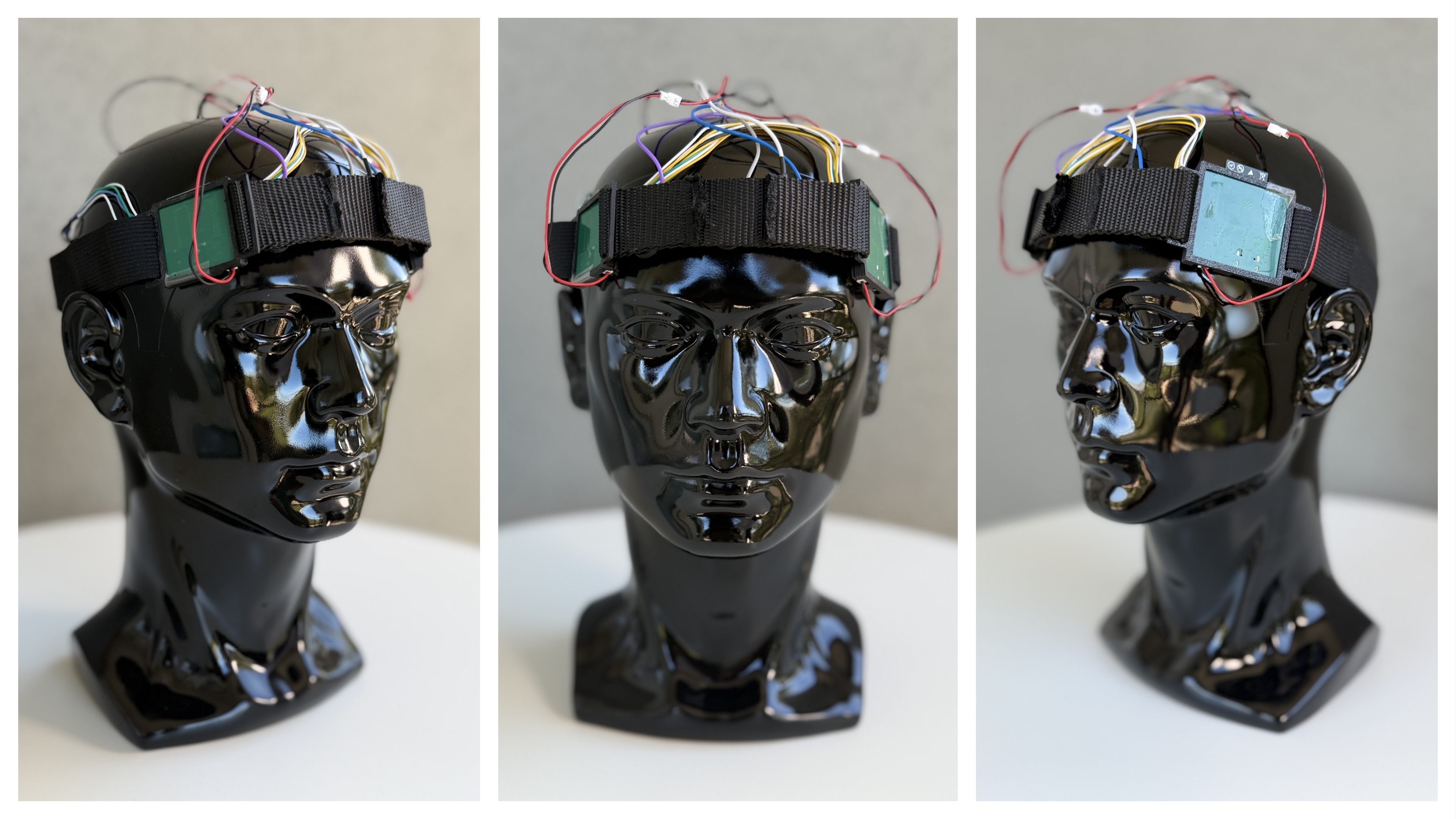
This project focuses on the design and development of a custom wearable platform for EEG and physiological signal acquisition. The system combines a custom-designed PCB, embedded electronics, sensor integration, and wireless communication to create a functional prototype for wearable neurotechnology research.
The platform was developed to explore the complete process of building a biosignal acquisition system — from hardware design and PCB fabrication to embedded data collection and wireless streaming.
System Architecture
The platform integrates multiple sensing modalities through a custom-designed wearable system for neural, physiological, and motion signal acquisition.
The hardware architecture is centered around the ADS1299 analog front-end for EEG signal acquisition, with additional sensors for physiological monitoring and motion tracking.
Key components include:
- ADS1299 — EEG signal acquisition
- MAX30102 — physiological monitoring
- LSM6DSO — motion sensing
- ESP32-S3 — embedded control and wireless communication
Custom PCBs were designed using KiCad, including schematic development, PCB layout, component integration, and hardware assembly. The development process involved component selection, datasheet analysis, circuit design, PCB fabrication, assembly, and hardware validation.
The embedded firmware was developed to configure sensors, acquire measurements, and transmit collected data wirelessly. The system successfully established communication with the integrated sensors and demonstrated BLE-based real-time data streaming from the wearable prototype.
The initial prototype also included mechanical iterations developed using Fusion 360 to explore PCB enclosure designs and wearable integration. Future iterations will focus on improving ergonomics, comfort, and long-duration usability.
Project Outcome
The project resulted in a wearable EEG platform prototype capable of acquiring and wirelessly streaming multimodal biosignals through a custom-built hardware system. The completed prototype demonstrated the feasibility of integrating neural, physiological, and motion sensing into a compact wearable platform, providing a foundation for future iterations focused on improved wearability, signal quality, and intelligent analysis.
Next Steps & Future Directions
Future development will focus on:
- Improving wearable form factor and mechanical design
- Expanding EEG sensing capabilities
- Developing signal processing pipelines for neural data analysis
- Developing machine learning approaches for neural signal interpretation